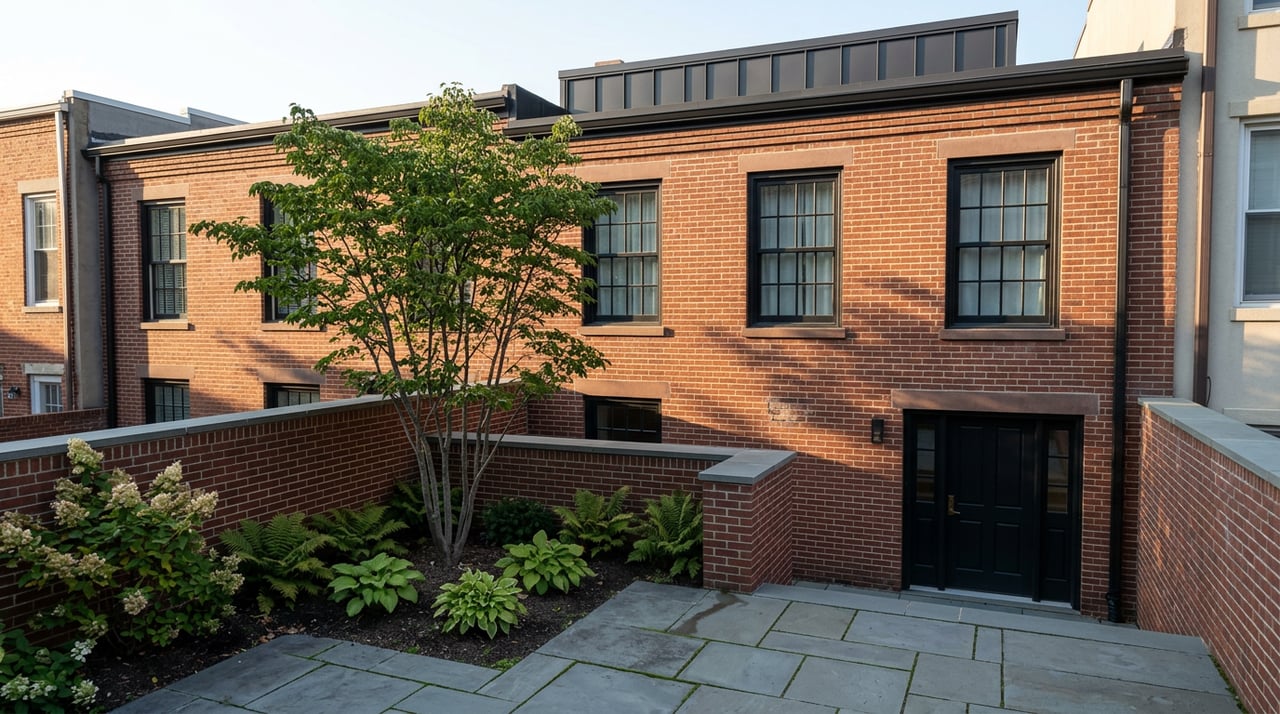
On August 4, 2026, the Landmarks Preservation Commission sat down to review a mixed-use rowhouse at 80 Horatio Street. Commissioners liked the rear elevation. They liked the rooftop addition. They liked the plan to excavate the cellar. Then they got to the ground-floor storefront, installed sometime in 1909 and not original to the 1853 building, and the room split. No vote was taken. The application simply carried forward, unresolved, to another hearing.
That is the detail buyers of landmarked West Village property tend to miss when they budget a renovation timeline. The commission does not only approve or reject. A third outcome exists, and it is the one that actually eats months: no action at all.
The Building That Wouldn't Decide Itself
80 Horatio sits between Greenwich Street and Washington Street, a five-story building that stayed in one family for nearly fifty years after Matthew Chirichella and Marshall Levine acquired it in March 1976. Last October, an entity called Jane St Garden LLC, led by the construction firm J.T. Magen & Company, bought it for $10.25 million, or roughly $1,671 per square foot of built space, on a lot measuring just 24 feet by 87 feet. The plan, drawn up by Allen + Killcoyne Architects, converts the current eight rental units into a single-family home standing 63 feet tall, with a rooftop bulkhead reaching an elevation of 74.83 feet.
Manhattan Community Board 2 recommended approval with modifications back in June. Then it went to the full commission in August, and that is where the storefront became the sticking point. Commissioners endorsed nearly everything else about the project but took no formal action on the application as a whole, splitting over whether a century-old, non-original storefront deserved to survive a full residential conversion. Victorian Society New York submitted testimony that day, a sign of how much civic attention a single storefront can attract inside this district.
The applicants came back with a revised design that folds an echo of the old storefront into the restored facade and lowers the top-floor rear windows. That revision went before the commission again on September 1. As of this week, no published outcome from that meeting has surfaced. The building may be resolved by the time you read this, or it may be back on a future calendar for a third look. Either way, the pattern is the lesson: a Certificate of Appropriateness hearing is not a single event with a guaranteed answer at the end of it.
What a Hearing Actually Produces
Most guides to landmark renovation describe the permit types accurately and stop there. The gap is in what happens once you're in the room.
| Permit type | Typical use | Review level | Typical timeline |
|---|---|---|---|
| Certificate of No Effect | In-kind repairs with no visible exterior change, as GalleryKB describes | Staff-level, no hearing | Roughly two to eight weeks |
| Permit for Minor Work | Small exterior changes like in-kind window replacement, as the Rand P.C. fact sheet describes | Staff-level, no hearing | Roughly four to eight weeks |
| Certificate of Appropriateness | Public hearing required, as Sherman Architects explains | At least 90 days |
A handful of narrower fast tracks exist, a 10-day review and a 5-day expedited path.
The timeline column above describes how long it takes to get to a decision, not how long it takes to get a yes. 80 Horatio has now been in front of the commission twice inside a single summer over one architectural feature. If that project needs a third hearing, the applicants absorb another 90-day cycle minimum, on top of the months already spent, before construction can begin.
The Loop, Not the Wall
A hearing is not a yes-or-no event. It can end with neither.
This is the part worth internalizing before you go into contract on a West Village property with renovation plans attached. The Havard Cooper guide says the commission's own sequencing rule is that landmark approval has to come before you can file for a Department of Buildings permit, not alongside it. If your Certificate of Appropriateness stalls on one contested detail, your DOB clock hasn't even started.
The 80 Horatio timeline shows the shape of that loop in real numbers. Community Board 2 review in June. A full commission hearing in August that resolved everything except one storefront. A revised submission and a second hearing in September. Each round adds design fees, holding costs, and carrying costs on a $10.25 million acquisition that, as of this writing, still cannot legally begin the covered scope of work.
None of this means the project will fail. Most Certificate of Appropriateness applications in the Greenwich Village Historic District, which the commission designated on April 29, 1969 and which protects more than 2,000 structures across 65 blocks, do eventually clear. It means the calendar you'd naturally assume, application filed, hearing held, decision rendered, permit issued, is not how it actually works when a project touches a genuinely contested feature.
What This Means Before You Sign a Contract
If a West Village property you're considering comes with renovation plans already attached, whether from the seller or from your own architect, a few questions belong in your due diligence before the ink dries:
- Is any proposed exterior change to this building already filed with LPC, and under which permit type?
- Has Manhattan Community Board 2 reviewed it, and did that review come with conditions?
- Is the work you're planning genuinely in-kind, matching existing materials and profiles, or does it change something visible from the public way?
- If a hearing has already happened once, what was the outcome, and is there a revised application pending?
That last question is the one most buyers skip, because "the commission met on this in August" sounds like resolved history rather than an open thread. As 80 Horatio demonstrates, a hearing date on the calendar tells you a meeting happened. It does not tell you the project is cleared to build.
The Premium You're Actually Paying For
None of this friction is a reason to avoid a landmarked purchase in the West Village. It's the reason the neighborhood holds its value the way it does.
StreetEasy's 2025 data put the West Village's median asking price at $1.775 million, more than 30 percent above the Manhattan median of $1.35 million. Fresher 2026 numbers tell a consistent story from the sales side: over the three months ending May 2026, the median sale price came in at $1.5 million, down 17.1 percent year over year even as price per square foot climbed to $2,570, up 33.9 percent over the same period, a split that points to smaller, higher-value transactions rather than a softening market. Sixty-six homes sold that May, against 65 average days on market, up slightly from 61 the year before. By August 2026, the neighborhood's median home price stood at $1,595,000, with four townhouses listed for sale ranging from $4.95 million to $12.5 million and averaging 98 days on market, noticeably longer than the neighborhood's typical listing.
That 98-day figure is not a coincidence. Townhouses are the property type most likely to carry landmark-dependent renovation scope, and the extra weeks on market reflect buyers and their lenders working through exactly the diligence this piece describes. It's the visible cost of scarcity. Roughly four out of five buildings in the West Village sit inside a historic district, which means the housing stock has effectively stopped expanding. New supply isn't coming to compete with what's already here. That scarcity is precisely what keeps values durable through cycles where other Manhattan submarkets soften.
A Short FAQ
Does landmark status mean I can't renovate a West Village property? No. It depends on scope.
How do I know if a specific renovation needs a full public hearing versus staff-level review? It depends on scope. In-kind repairs with no visible exterior change typically qualify for a Certificate of No Effect. A Certificate of Appropriateness requires a public hearing.
What happens if a previous owner did unpermitted work? This is worth confirming during due diligence.
How long should I actually budget for a Certificate of Appropriateness? Plan for at least 90 days. If any part of your plan resembles the kind of feature that split commissioners at 80 Horatio, a distinctive historic element with its own advocacy behind it, build in room for a second hearing.
If you're weighing a West Village purchase with renovation plans in mind, the numbers above are a starting point, not a substitute for a building-specific read. Iryna Ferenets works with buyers across Manhattan's historic districts and can help you figure out, before you're under contract, exactly what a given property's landmark history means for your timeline and your budget.
This article is general information, not legal, tax or financial advice. Consult a qualified professional about your situation.



