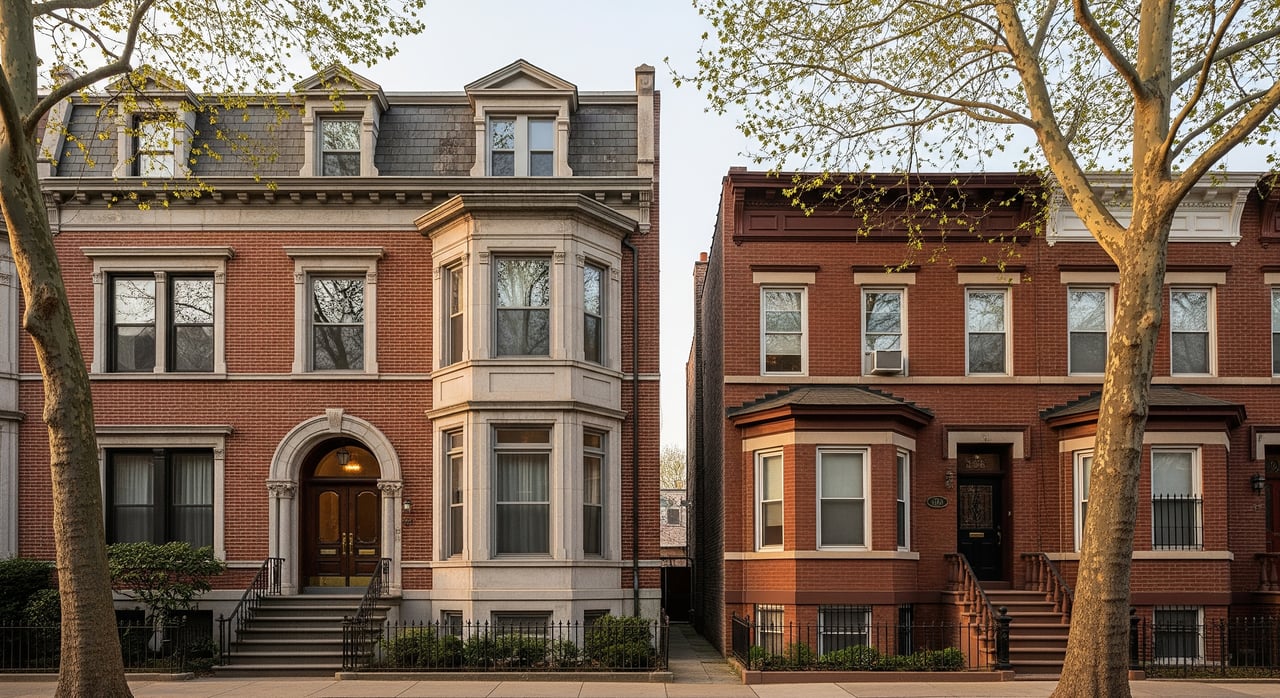
Shopping in Ridgewood and wondering if your mortgage will be jumbo or conventional? The answer comes down to a single number and how your down payment lines up with it. You want clarity on costs, requirements, and what to do next so you can move confidently. In this guide, you will learn the Queens 2025 loan limit, how lenders treat jumbo vs. conventional loans, and real Ridgewood scenarios that show where your deal will land. Let’s dive in.
Conforming vs. jumbo basics in Queens
The rule that decides your loan type
A loan is conventional conforming if your loan amount is at or below the local limit set each year. For 2025, Queens County’s one‑unit conforming ceiling is $1,209,750. That means your mortgage can be conforming even on a seven‑figure purchase if your loan amount after down payment is at or below that limit. You can review the national announcement from the regulator and confirm county limits through trusted sources like the FHFA and county tables.
- Review the 2025 conforming limits and high‑cost ceilings from the regulator: FHFA 2025 conforming loan limits
- See county limit references for Queens: Conforming loan limit lookups
What changes for you as a borrower
Jumbo loans exceed the applicable conforming limit, so lenders apply tighter standards. Here is what that usually means for you.
- Credit, DTI, and reserves: Conforming loans can allow lower credit scores, higher debt‑to‑income ratios, and fewer months of reserves. Jumbo programs often expect higher scores, lower DTI, and 6 to 12 months of reserves. Bankrate’s overview of jumbo vs. conventional explains these differences.
- Rates and fees: Jumbo rates used to be much higher, but from 2023 through 2025 spreads have narrowed. Pricing varies by lender and your profile, so compare quotes. Larger loans may also bring higher appraisal costs and origination fees. See the Bankrate comparison.
- Mortgage insurance: Conforming loans with less than 20 percent down usually require PMI until you reach 20 percent equity. Many jumbo products avoid PMI by requiring bigger down payments, though some allow lower down payments with different pricing. Learn more in this PMI and loan type explainer.
Ridgewood price context and timing
Why many buyers sit near the limit
Ridgewood’s typical sale prices often fall in the low to mid seven figures based on 2024 to 2025 market reads. That puts many buyers close to Queens’ high‑cost ceiling. The takeaway is simple: a small change in your down payment can push your loan under the limit and keep you in conforming territory.
Rate environment and monthly impact
Mortgage rates in 2025 have hovered in the mid‑6 percent range on average, though they move week to week. Even a modest rate change can shift your monthly payment and the total cost difference between jumbo and conforming. For current context, see the Freddie Mac weekly rate report.
Closing taxes and NYC buyer costs
Plan for New York City and New York State transfer taxes at closing. In NYC, the Real Property Transfer Tax is generally 1 percent for sales at or below $500,000 and 1.425 percent for sales above $500,000, typically paid by the seller, though contracts can negotiate terms. Review the NYC RPTT guidance. If your purchase price is $1,000,000 or more, the New York State “mansion tax” applies, starting at 1 percent and increasing at higher tiers. Learn more from the New York State Department of Taxation.
Ridgewood buyer scenarios
Scenario A: First‑time buyer around $675,000
- Price: $675,000. With 5 percent down, your loan is about $641,250, which is well below Queens’ conforming ceiling. Conforming or FHA options could work depending on your credit. With less than 20 percent down on a conforming loan, expect PMI until you build equity.
Scenario B: Median‑area purchase near $1,200,000
- Price: $1,200,000. With 20 percent down, the loan is $960,000, which is conforming in Queens. With 5 percent down, the loan is $1,140,000, still conforming but likely with PMI and tighter DTI checks. In this range, it pays to compare the cost of PMI against increasing your down payment.
Scenario C: Higher‑priced single‑family at $1,500,000
- Price: $1,500,000. With 20 percent down, the loan is $1,200,000, which is slightly below the $1,209,750 ceiling. That keeps you in conforming territory. Small shifts in price or down payment near the limit can tip you into jumbo, so verify the numbers before you offer.
Scenario D: When a jumbo is required
- Price: $1,600,000 with 10 percent down. The loan is $1,440,000, which is above Queens’ conforming ceiling, so a jumbo product is required. Expect tighter underwriting, possible rate premiums, and higher documentation. If you can raise the down payment so the loan drops under $1,209,750, you may unlock conforming pricing and broader lender options.
Scenario E: Owner‑occupied 2 to 3 unit
- Ridgewood has many small multi‑family homes. FHA sets higher limits for 2 to 4 unit owner‑occupied properties in high‑cost counties and requires you to live in one unit. FHA loans also require mortgage insurance. Check current limits and rules in the HUD 2025 update.
Scenario F: Co‑op purchase realities
- Co‑op boards often set their own financial standards, such as higher minimum down payments, stricter DTI targets, and post‑closing liquidity. Some buildings limit financing or may be non‑warrantable, which affects which lenders and products are available. See general project eligibility concepts in Fannie Mae’s co‑op guidance.
How to choose your best path
Use this quick checklist to decide and prepare.
- Calculate your loan amount vs. the limit: Price minus down payment determines conforming vs. jumbo. Confirm the year’s limit for Queens in the FHFA 2025 announcement.
- Get full preapproval from at least two lenders: Compare one local bank or credit union with one larger lender. This reveals whether you qualify for conforming pricing or need a jumbo and what reserves are required. See lending differences in Bankrate’s guide.
- Model a few down payment options: If your loan is near $1,209,750, small changes can move you into conforming and broaden your options.
- Verify co‑op policies early: Ask for the building’s financing rules and financials to confirm warrantability and board standards. Cross‑check with your lender’s co‑op requirements.
- Budget for NYC taxes and fees: Account for RPTT, state transfer tax, and the mansion tax where applicable. Start with NYC RPTT and the NY State transfer and mansion tax page.
- Consider assistance programs: NYC’s HomeFirst program can offer down payment help to eligible first‑time buyers, which may keep your loan within conforming limits. Explore HomeFirst details. SONYMA programs may also help if you qualify.
Ready to buy in Ridgewood?
If you want a clear, numbers‑first plan for your Ridgewood purchase, let’s map your options side by side and align the financing with your goals. With deep Queens market experience and close coordination with vetted lenders and attorneys, you will move from preapproval to board package to closing with confidence. Start your strategy session with Iryna Ferenets.
FAQs
How do I know if my Ridgewood loan is jumbo?
- Compare your planned loan amount, not the price, to Queens’ 2025 limit of $1,209,750. If your loan exceeds that number, it is jumbo. See the FHFA 2025 conforming limit announcement.
Do million‑dollar Queens homes always need jumbo financing?
- No. Many seven‑figure purchases still qualify as conforming if your down payment brings the loan at or below $1,209,750.
Are jumbo mortgage rates always higher than conventional?
- Not always. Since 2023 to 2025, the rate gap has narrowed. Pricing depends on your profile and lender competition, so compare quotes. See Bankrate’s jumbo vs. conventional overview.
How do co‑ops affect financing in Ridgewood?
- Co‑op boards often require larger down payments, lower DTI, and strong post‑closing liquidity. Some buildings are non‑warrantable, which limits loan options. Review Fannie Mae co‑op eligibility concepts and confirm with your lender early.
Can FHA or assistance programs help me avoid a jumbo?
- Possibly. FHA limits are higher in high‑cost areas and require owner occupancy, plus mortgage insurance. Assistance like NYC’s HomeFirst can boost your down payment so your loan fits within conforming limits. See the HUD 2025 update for FHA context.



