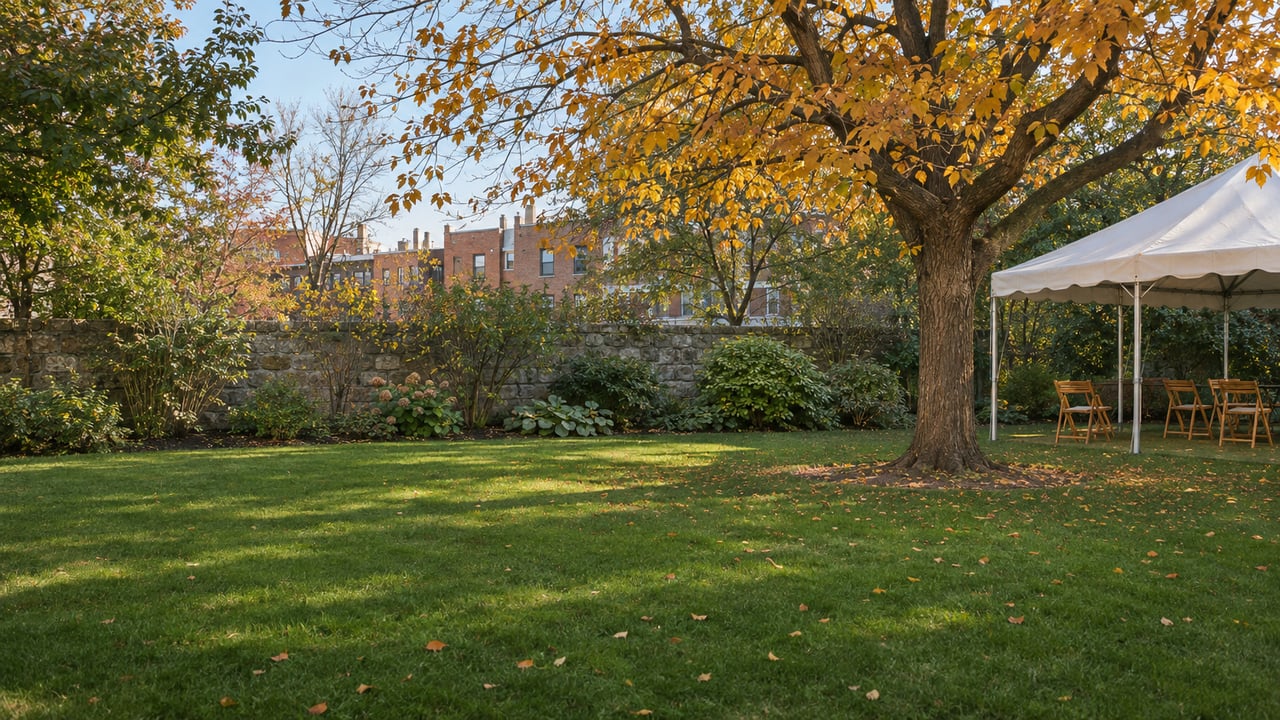
The gate on Onderdonk Avenue is still where you go in. Behind it, the Vander Ende-Onderdonk House at 1820 Flushing Avenue has construction fencing around it, and the stone farmhouse that Paulus Vander Ende began building in 1709 is getting the largest exterior restoration of its time as a museum. The Greater Ridgewood Historical Society has kept its calendar going on the back lawn and in a tent. That calendar is now the only way the public can get onto the property, and it has two Sundays left on its 2026 list.
The house is closed. The tent is the way in.
In a normal year, a weekend ticket covers three floors of exhibits about the families who lived in the house, plus the grounds, the seasonal gardens and Arbitration Rock, the old boundary marker between Brooklyn and Queens. Admission is charged for the grounds as well as the house. This season the society's Plan a Visit page says the museum is "temporarily closed for tours on Saturday and Sunday," weekend tour tickets aren't for sale, and public programming is running "in the back lawn and tent."
So for now, a ticket to a program is how you get to the Onderdonk grounds. The fall season has been running that way since October. The Harvest Festival on October 11 had its pumpkins, butter churning and apple pressing, but no museum tours, a change the Queens Chronicle reported ahead of the event. A hand-dipped candle workshop followed on November 8. Here is what remains on the society's events calendar for 2026:
| Date | Program | Where | Tickets |
|---|---|---|---|
| Sunday, November 15, 1:30 p.m. | Stockholm Street Walking Tour | Meets at the Onderdonk Avenue gate | Ticketed; see the event listing |
| Sunday, December 6, noon to 4 p.m. | St. Nicholas Day | Museum grounds and tent; enter at the Onderdonk Avenue gate | $5 general; free for children under 12 |
What the fence is around
The work behind the fence has been in the queue for years. As QNS reported in June, the restoration effort started in 2014 with the gambrel roof, and the society launched the wider exterior campaign in 2017. The Queens Chronicle reported that the roof was replaced after the one from 1980 started to leak. That was the year the house was restored after a fire and opened as a museum.
According to the Queens Chronicle, contracts for this phase were awarded in May. City construction funds, including contingency, total $1,338,001. The money comes through the Department of Cultural Affairs and discretionary funds from City Council Districts 30 and 34 and the Queens Borough President's Office. QNS adds that the city's Department of Design and Construction did the planning and design and is managing construction.
From the two reports, here is what that money covers:
- The stone walls. QNS lists pointing and structural restoration of the main house's masonry. The planning study found cracks that, per the Queens Chronicle, "weren't structural" and only needed patching and restoring, in the words of Linda Monte, the society's chair of programs and education.
- The wood. Clapboards on the frame addition, plus windows and wood trim on both parts of the house.
- A front gutter. The roof was designed to shed rain, but the runoff landed on the brick walkway and made it a hazard for visitors.
- The first floor. New wooden floorboards that Monte said will no longer be "springy" for repeat visitors.
- The cistern. It had been covered with plexiglass so no one would fall in, and Monte told the Chronicle the cover "made a little greenhouse" that led to overgrowth.
Monte called the cistern the most obvious change. She described the payoff this way in the Queens Chronicle:
"We're really excited about that, because visitors will now be able to actually see and look into it, to see the original cistern where water was stored for the families that lived there."
She also told the paper the project is "really the culmination of the exterior of the house." QNS gave summer 2027 as the estimated completion date. For anyone on the lawn this fall, that means watching a house that has stood since 1709 in the middle of repairs to its walls, windows and floors.
November 15: the tour that leaves the fence behind
The next program doesn't depend on getting into the house at all. On Sunday, November 15, the society's Stockholm Street Walking Tour meets at the Onderdonk Avenue gate at 1:30 p.m. and heads to what the society calls "NYC's smallest Historic District." It runs rain or shine.
The block has its own landmark file. The Landmarks Preservation Commission designated the Stockholm Street Historic District on November 28, 2000. The commission's report describes one block with 36 houses, a former stable and two garages on a brick-paved street. It points to the full-width wooden porches, projecting bays and continuous cornice lines, and notes that the paving is Ridgewood's only surviving brick street pavement. According to the LPC, 35 of the houses went up between 1907 and 1910. The commission calls the block an unusually intact and harmonious ensemble of working-class housing.
The timing works in the tour's favor. With the museum closed, this is the one program on the 2026 calendar built around architecture you can walk up to and study closely. It also covers two landmarks that were designated five years apart, the house in June 1995 and the street in November 2000.
December 6 closes out the 2026 calendar
St. Nicholas Day is the society's yearly holiday program, and it is the last date on the society's list of upcoming events for 2026. It runs Sunday, December 6, from noon to 4 p.m., with last entry at 3:45. Visitors come in through the Onderdonk Avenue gate. The grounds will be decorated outdoors, and the tent will host photos with St. Nicholas. Children get goody bags with a craft to take home, and refreshments will be for sale.
The house page explains why the date fits the setting. St. Nicholas Day "is still widely celebrated in Europe and by many Dutch and European families here in America," so it suits a Dutch Colonial farmhouse well. General admission is $5, and children under 12 get in free. Every attendee needs a ticket, children included, so book the whole group.
The day also runs a toy drive. The society is partnering with the 104th Police Precinct's Community Affairs unit, which will collect new, unwrapped toys and gifts for children ages 1 through 18 on behalf of families at Summerfield Family Residence. Tickets are on the St. Nicholas Day event page. The program is supported by public funding from the NYC Department of Cultural Affairs in partnership with the City Council, along with the society's members.
After that, winter programs move off the property
The society's events page says its 2027 winter events will be held at other community locations and asks visitors to check back for details. The Queens Chronicle reported the same plan. It also quoted Monte on the year ahead, saying the society won't be able "to show off the museum and have people visit it for about a year."
The tent won't stay empty for long. According to QNS, the society is planning more events in the tent through spring 2027, including the Eggstravaganza and its walking tours. Exterior work is expected to finish around summer 2027. When the fence comes down, visitors will find a firmer first floor, a gutter over the brick walkway, and a cistern they can look into.
The Onderdonk House restoration is a reminder that in Ridgewood's landmarked pockets, from Flushing Avenue to Stockholm Street, exterior work runs on long timelines. If you own a home near either landmark and want to know how that history and preservation work figure into its value, Iryna Ferenets can walk you through it, starting with an instant home valuation.



